Showing posts with label drama. Show all posts

Tuesday, May 29, 2012

Why See This...The Best Exotic Marigold Hotel [2012]

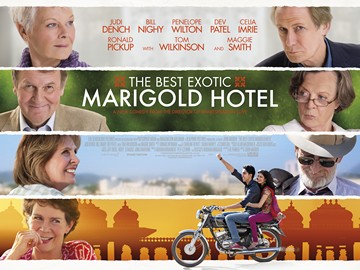
      The Best Exotic Marigold Hotel is a coming of age story in a rather unlikely way.  Its main characters are not novice youngsters or young adults feverishly searching for their life’s purpose in the many daunting years ahead of them.  Hardly.  Instead, the characters that make up this story are all well over the hill and have had plenty of that kind of life experience.  But despite its displacement in the traditional sense of that genre, The Best Exotic Marigold Hotel basks in the seemingly youthful splendor and energy of a coming of age story.
      Immediately, the audience receives a crash course of introductions by way of the film’s seven main characters, all living in various parts of England, all unknown to each other’s own existence.  There’s the newly widowed housewife, Evelyn (Judi Dench), looking to sell her home and pay off her family’s debts; another woman, Muriel (Maggie Smith), in need of an affordable hip replacement (who is also racist); a judge by the name of Graham (Tom Wilkinson), who has been telling himself for years he will soon retire; Norman (Ronald Pickup), a single man of the Don Juan type always looking for some fun under the sheets despite his old age, Madge (Celia Imrie), a woman of similar stature that, despite a few unsuccessful marriages, still hopes to be swopped off her feet by a beloved Prince Charming.  And then there’s the groups’ only married couple, Douglas (Bill Nighy) and Jean (Penelope Wilton), who still appear much too young for their retirement community home, fit with too many handrails and an emergency button- but it’s all they can afford.  What groups these people together is the tight budget they must plan their retirement on, making this comfort that much harder to attain.  The introductions become hectic at first and almost too much too soon, but through each of their three minutes of screen time, we see that none of these folks are cinematic caricatures.  Each one is cleverly thought out and totally real.  No doubt there is a lonely Evelyn and a feisty old Norman out there in our world.  Their individual stories make the film much more real and relatable.  In their own ways, each character is trying to re-attain the peace of mind they had from years prior and this subsequently takes them to the same destination- India, where they all meet.

Monday, May 14, 2012

Why See This...Rope [1948]


      I was searching for the exact quote of something along the lines of “you don’t know until you try.”  I typed those words into Google and much to my dismay, it gave me all sorts of inspirational/proactive “you’re actually really intelligent so you should rediscover yourself” types of websites.  Good stuff and all, but that was not exactly the direction I wanted to begin my review of Rope with.  I thought all hope was lost until Bruno Mars saved my day. (I will never say that again.)  Towards the bottom of the search was a page of lyrics to his song “The Other Side” as it aptly contains the phrase “It's better if you don't understand 'cause you won't know what it's like until you try.”  Perfect!  Now I was back, all thanks to Bruno Mars.
      As he tells us, sometimes it is better if you don’t understand some things, like the feeling of killing another man as this is what occurs within the first few seconds of Alfred Hitchcock’s 1948 suspense-thriller Rope.  Brandon and Phillip, the two men who strangle their friend, David in their apartment with a piece of rope (hence the title) hardly fit the profile of two murderers.  They come from wealthy New York families, the type that sends their children through years of expensive boarding school before entering college as the boys did.  And unlike most murderers, their willingness to take a man’s life comes not from any amounts torment or revenge.  No, Brandon and Phillip kill this man simply out of sheer curiosity of knowing what it feels like to kill.  Fascinated by the superhuman philosophy of Nietzsche as taught to them in school by their former boarding school professor and friend Rupert Cadell (James Stewart), the boys decide to take his nihilistic words into action.  But personally, murder as an experiment just makes it even more disturbing.

Friday, January 20, 2012

One Long Look...Children of Men [2006]

      Today I want to begin a recurring segment on FILMclatter called “One Long Look...” where I feature spectacular examples of camera work in some of my favorite movies.  The only requirement then is that the shot must be really long.   A long take is hard to come by in movies these days.  And even when it does show up, most viewers don't expect the long take and fail to recognize the sot for what it's worth.  Not to get pretentious and say that film isn’t what it used to be, because that argument is long and boring, and rather useless.  Editing has its place in movies and without it we would have far less cool car chases at our hands.  On the other side of the spectrum, the long take has its own purpose and splendor in the movies.  A chase scene filmed entirely in one take would be a spectacular feat but it would be pretty boring to watch.  There are no cuts and generally no tricks; a long take is exactly what it sounds like.
      And that may sound boring, but in the first segment of “One Long Look...” I would like to feature a shot from the 2006 sci-fi film Children of Men.  The word 'boring' has never been associated with this movie.  Set in the year 2027 we are taken into a future filled with chaos where humans can no longer pro-create and the world's future looks bleak.  Known as one of the most spectacular feats in filmmaking history, this six minute single shot allows viewers to follows one man in and out of dilapidated buildings, dodging bullets, running for his own life as well as for the sake of humanity.  It is an unusual scene in that fast cuts and editing would normally heighten the unsettling and dramatic quality the director is trying to achieve.  But this is clearly not the case here. 


Friday, January 13, 2012

Reel News...First Trailer for Moonrise Kingdom

      From his quirky, satirical comedies in The Royal Tenenbaums and The Life Aquatic with Steve Zissou to his last film, the stop-motion animated Fantastic Mr. Fox, complete with talking animals, anyone who is familiar with the work of Wes Anderson knows the age old phrase "expect the unexpected" thoroughly applies to this man almost more than anyone.  His latest film, Moonrise Kingdom, in which he resorts back to live animation, is no exception to this.
      Other than Fantasctic Mr. Fox, Anderson's films have generally been seen as comedies aimed at adult audiences.  Yes, they are sometimes crude but what adult comedy isn't these days?  In tune with the laughter, what Anderson does so marvelously in his films is create these "grown up comedies" with a charming and nostalgic hint to them.  His ensemble pieces tend to have more than their fare share of off-beat characters who can do nothing else but screw up and yell at each other.  One can feel no shame in laughing at these people but more so, in the case of The Royal Tenenbaums, a smile might arise when instinctively seeing your own family members on the screen.  Thus, more times than not, the laughter then comes from these engaging and seemingly personal moments.
      It appears no different in the case of Moonrise Kingdom.   Set amidst a children's summer camp in the 1960s, two young campers, Suzy and Sam, take on a relationship that provokes them to run away from their camp.  As a result, all hell breaks loose at the camp.  All of the adults in this film are completely inept and dysfunctional as superiors to these kids and Anderson has an elite cast of A-listers to go with in Bruce Willis, Bill Murray, Edward Norton, Tilda Swinton, Frances McDormand and Harvey Keital, who between the six of them have nine Oscar nominations (two wins).  With that bunch on had, its anyone's surprise that none of them take a lead role in the film.  Instead, Anderson leaves the top bills to the youngsters who play Suzy and Sam, both of which have never acted on the big screen before.  It looks terrific, but I expect nothing less from Anderson these days. It's certainly a top pick of mine for 2012.


Moonrise Kingdom is set for a May 25th  release in the United States


Friday, January 6, 2012

Useless Clatter...Oscar Predictions 2012

With the Academy Awards looming (Feb 26th) and most of the big hitters out by now, I decided to post some predictions for the major categories. Not that sound-mixing and make up are not important,  I just can't differentiate explosions or eyebrows as easily.  As we near the date and the official nominations come out, I will post those and then make my final predictions.

+ these are in no particular.
+ designates additional nomination beyond allowed five
Best Picture
The Artist
The Descendants
The Ides of March
The Help
J. Edgar
Tinker, Tailor, Soldier, Spy
The Tree of Life
War Horse

Best Director
Michel Hazanavicius The Artist
Tomas Alfredson Tinker, Tailor, Soldier, Spy
Alexander Payne The Descendants
Terrence Malick The Tree of Life
Martin Scorsese Hugo
+ Sean Durkin Martha Marcy May Marlene

Actor In A Leading Role
Leonardo DiCaprio J. Edgar
Jean Dujardin The Artist
Gary Oldman Tinker, Tailor, Soldier, Spy
Brad Pitt Moneyball
Demian Bichir A Better Life
+ Michael Fassbender Shame

Actress In A Leading Role
Viola Davis The Help
Michelle Williams My Week With Marilyn
Glenn Close Albert Noobs
Charlize Theron Young Adult
Meryl Streep The Iron Lady
+ Elizabeth Olsen Martha Marcy May Marlene
 
Best Supporting Actor
Christopher Plummer Beginners
Patton Oswalt Young Adult
Nick Nolte Warrior
Jonah Hill Moneyball
Kenneth Branagh My Week With Marilyn
+ Armie Hammer J. Edgar

Best Supporting Actress
Octavia Spencer The Help
Bérénice Bejo The Artist
Shailene Woodley The Descendants
Jessica Chastain The Help
Carey Mulligan Shame
+ Melissa McCarthy Bridesmaids

Best Original Screenplay
Woody Allen Midnight in Paris
Tom McCarthy and Joe Tibani Win Win
Diablo Cody Young Adult
Mike Mills Beginners
Jeff Nichols Take Shelter
+ Dustin Lance Black J. Edgar

Best Adapted Screenplay
Bridget O’Connor & Peter Straughan Tinker, Tailor Soldier Spy
Tate Taylor The Help
John Logan Hugo
Aaron Sorkin & Steven Zaillian Moneyball
Nat Faxon, Alexander Payne & Jim Rash The Descendants
+ Steven Zaillian The Girl With The Dragon Tattooo

I decided to stop after the main eight categories.  Like I said, I don't know enough to make guesses on each and every category, and these eight are always the most talked about.  The selections above seem to be the general consensus around the web, with a few of my own particular hopes thrown in the mix.
By the way, here's a short little trailer for the upcoming ceremony hosted by Billy Crystal.  Its a bit goofy, but I think their off to a better start than last year.


Tuesday, January 3, 2012

Why See This...Melancholia [2011]

   Our culture seems to have embraced the idea of an apocalypse, if merely for our own entertainment.  Society's growing interest in this topic is seen on various TV shows such as History Channel’s Life After People and AMC’s hit series, The Walking Dead.  But the fascination is neither new nor solely a media craze.  Robert Frost gives us his own brief take on the apocalypse in his poem "Fire and Ice" in 1923 and we are all aware of the ancient Mayan’s prediction falling on the date of  December 21 of this year that has yet to be tested.  And of course, who could forget the rapture that was supposed to destroy the earth last May?
      But whether it’s a cosmic explosion, a global zombie-infecting virus or the result of some ancient Mayan voodoo, one edition that serves up the world’s end in an idyllic gambol is Lars von Trier’s latest film, Melancholia.  Not one to shy away from controversy from his ramble sympathizing with Hitler at Canneshis new tattoo and to his last feature, the 2009 film, Antichrist, few could ignore talks of him directing an apocalyptic tale.
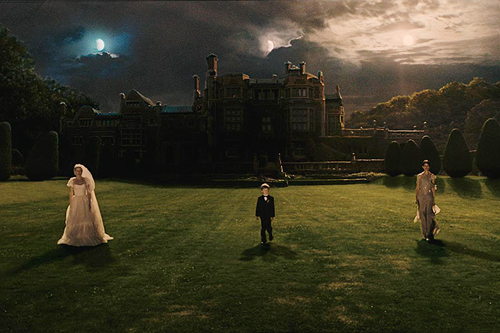
      And that’s what this film is- another rendition of the end of the world.  But under the creative control of Lars von Trier, it sets itself apart from any other apocalyptic piece.  Melancholia, which serves as the film's title, is a distant planet in outer space that scientists believe will collide with earth within the next few days. The film opens with a harrowing sequence of slow moving frames.  In each one, we see the film’s main character, Justine, given an award-winning performance by Kirsten Dunst (winning Best Actress at Cannes), and in them all there lies a look of despair and agony on her face.  In one, she is seen wearing a wedding gown running through a forest whose branches and vines grasp hold of her feet.  In another, she is again running but this time her captor comes in the form of a lush green prairie in which a step down proves to be quicksand, again leaving her with a similar fate.  All within the orchestral backdrop of Richard Wagner’s Tristan und Isolde giving the film an unnaturally eerie yet majestic tone.  With this ill fated montage, von Trier chooses to hint towards the fate of these characters before ever receiving an introduction. 
      The film’s action opens at Justine’s wedding at a massive castle.  She and her newlywed husband are late arrivals to their own wedding party, much to the dismay of their guests.  But the couple does not seem anxious or eager to attend. Instead, they display affectionate laughs toward each other in their limo as if unaware of their untimely arrival.  From the point of their late entrance, the merry expression on Justine’s face is absent the remainder of the film.  A far planet named Melancholia, which serves as the film’s title, is quickly approaching the earth’s orbit and much like our own Rapture, it’s caused a mix of emotions and scientific tests to try and decide if it will hit our planet, ending it all.  Melancholia, without coincidence I assume, seems to be the cause of Justine’s depressed state during her own wedding.  The idea of the end is too unbearable for her, yet she seems to be the only one attuned to this fear as the party’s guests continue on with pleasure while she partakes in her solitary anguish
      Melancholia's focus, then, is on the remaining days as played out by Justine, her sister Claire and Claire’s husband and young son.  It serves to be quite emotional as we sit and wait for their world’s end, watching these characters reconcile with this stark reality before then from our safe position as the film’s audience.  But what’s before them, an end not entirely certain provides excitement for the husband and son as they abide to discussions of a safe passing of Melancholia just outside the earth’s orbit. For them, it will provide a once-in-a-lifetime glimpse of interstellar beauty. 
      Not to give away any details unknown, the film’s final scene, which includes the world’s end, provides an image more fascinating than menacing- no fire, no ice, no zombies.  While destructive in nature, Lars von Trier‘s finale turns the apocalypse’s destructive nature into something more beautiful- it ends as it all started with a bang.  But in his view, the bang is more than a split second; he draws out the earth’s final moments with a symphonic score that matches the powerful imagery of our world coming to an end. 
      Before seeing the film, one must understand the directing of Lars von Trier.  In 1995, he wrote a piece called the “Dogme 95 Manifesto” which called for a return to the traditional means of film production, excluding much of the elaborate tricks used by studios today.  For that matter, most of the shots of Melancholia consist of nothing more than the director himself and a handheld camera, resulting in constantly shaking frames for the film’s entire running time.   Combined with his controversial themes, many tend to discredit von Trier’s filmmaking abilities, but to look past these “technical blemishes” is to experience a splendid and thought provoking film of another yet masterful take on the end of the world.


Reel News...New Trailer For The Dark Knight Rises

      The conclusion of Christopher Nolan’s Batman franchise, The Dark Knight Rises, has released a new trailer for the film.  This third and final installment sees the return of its major stars in Bale (Bruce Wayne/Batman), Caine (Alfred Pennyworth), Oldman (Police Commissioner) and Freeman (Lucius Fox)  in their respective roles as protectors to Gotham City while introducing a new slew of enemies in Catwoman (Anne Hathaway), Bane (Tom Hardy) and others out to destroy Gotham City.
      Nolan, also director of the Inception, signed a few notable stars from this film to join the cast of the final Batman.   Joseph Gordon-Levitt, Tom Hardy and Marion Cotillard all have roles in the upcoming film.  Other new characters include a number of Pittsburg Steelers who will make cameos as the fictional Gotham Rogues football team as we get a quick glance of Hines Ward (86) in the trailer.
      While I am not a huge fan of superhero flicks, Nolan’s Batman series is a definite exception.  I am equally excited for the film’s release as well as saddened in knowing that it will be the last.  Judging by the trailer, The Dark Knight Rises looks as if it will match the dark, suspenseful tone of its prequel.  Hopefully Batman will certainly rise and not succumb to the evils that lurk beneath Gotham City.  But after watching the trailer, we can see he’s got a lot of work cut out for him.


The Dark Knight Rises opens in theaters July 20, 2012.

Monday, January 2, 2012

Why See This...The Panic in Needle Park [1971]


      One year prior to playing pristine mobster son Michael Corleone in The Godfather trilogy, Al Pacino found himself immersed in a different type of criminal as Bobby in The Panic in Needle Park (1971).  But unlike in The Godfather, his crimes failed to bring in the glory and riches he garnered as the mobster Corleone.  Instead, his heroine use pushed him to scourge the dirty streets and alleyways of 1960s New York, performing petty crimes to fill his empty pockets and get his daily fix.  This is emphasized to the point that we never see Bobby’s home in the film.  “I gotta lot of places” he says at one point.  Early on, this statement holds a possible truth.  He could in fact be a big time pusher with spots throughout New York; however, the more we watch, we soon find out that's far from the truth.  He hides the fact that he has no permanent place he can stay and instead, his drug use forces him across the city streets each day.  His main spot though is on the corner of Broadway and 72nd Street at Sherman Square, otherwise known as Needle Park- a junkie hangout named for obvious reasons.
      Actually, the first sequence of the film does not introduce Bobby, but another lost yet innocent soul, Helen.  She’s on her way back from what we find out later to be an abortion; however she's not on her way home.  Instead she’s going back to boyfriend’s place who, as she enters the room, is picking up a bag of heroine from Bobby.  Shortly after, Helen’s boyfriend bails on her and leaves town, at which point she falls for Bobby very shortly after.  The film does not waste any time explaining why they are attracted to each other- they're both young, lost and in love and by the looks of it, they both need someone to hold on to  Helen find’s Bobby’s hard handed, drug filled lifestyle to be an exciting change from her boring and ordinary life.  “I was born and went to school” is the only description she gives about her life before Bobby.  Tailing Bobby throughout the remainder of the film, Hellen is introduced to the many aspects of drug culture and at the same time, so are we.
      The film follows cinéma vérité in which a narrative film is stylized to appear almost as if it was a documentary.  Its close observance of drug culture forces the film to exclude intense action and cop chases that appear in other drug-based films like The French Connection.  Instead The Panic in Needle Park prefers for long uninterrupted sequences where we find ourselves holed up in a small apartment watching needle injections and heroin ODs.  Two scenes from the film come to mind- One is the first time we see Bobby and his friendly addicts use heroin.  All crammed into a tiny room, the camera focuses on a select individual as we watch him through the entire process up to the point of injection.  (Supposedly, the actors use real heroin, but this is neither claimed nor denied by its makers.)  The second scene, in a similar setting, is one where Bobby finds himself at the heart of New York’s heroin trade witnessing an assembly line of people weighing and packaging heroin together to sell on the streets.  His eye-opening amazement at the amount of heroin found in one place clashes with our own amazement of the highly organized drug production that could take place within any old apartment room.  The film though in its documentary-like observance of heroin addicts is also a love story between Bobby and Helen, who quickly becomes sucked into the addiction just like Bobby.  She slowly succumbs to heroin throughout the film and even turns to prostitution as a way to make money.
      Even more, everyone always runs the running risk of being snitched on by other users.    When there's no heroin available, its known as a 'panic' and as expected with any addict, they get desperate.    Two low-level police offers in the movie work as rats on the streets asking small timers like Bobby and Hellen for information about the big time dealers cutting them deals for information.  Desperate times call for desperate measures and many times in Needle Park, we watch Helen battle as she battles with this exact dilemma when given a wager by the police.  "Everybody rats," they tell her.
      What’s most effective about The Panic In Needle Park is actually what it lacks and this is music.  None is heard throughout the film giving Needle Park the empty and eerie feeling one would probably really get if they ever found themselves walking through it.  The lack of music also gives way to excellent acting performances by Pacino and Kitty Winn, whose portrayal of newbie drug addict Helen earned her the Golden Palm Award at the 1971 Cannes Film Festival.  In the end, The Panic in Needle Park stands out for its gritty and graphic display of the lifestyle of two young heroin addicts who try and fall in love in Needle Park.  As the screen goes black and the credits roll by in silence, the audience is left with contradicting emotions- sympathy for their romance but disgust for their actions along with a  sense of worry of what their fate make of them.  Lastly, what enters me is amazement as I am left wondering how a film that so truthfully display the darkness of heroin could turn out so beautiful and become one of my all time favorites movies.


                                                            The Panic in Needle Park trailer
+I should probably mention that aside from the trailer's narration by Hellen, there is no use of it throughout the film; however, it was the only trailer I could find on YouTube.