Monday, June 25, 2012

Why See This...Moonrise Kingdom [2012]


As Moonrise Kingdom begins, its opening shots cleverly create the illusion that what you are looking at is not a movie.  What we see through the deliberately square and mechanically positioned camera is a series of perfectly set up rooms in a quaint New England styled cabin.  Everything in them so perfect and so intricately positioned that the frames look more like static pictures than a movie.  For a visual comparison, I immediately thought of the Thorne Miniature Room Gallery at the Art Institute of Chicago as I watched the film.  These miniature rooms bear a certain resemblance to the look of a Wes Anderson film. Whether they look like one of the cottage rooms from Anderson’s opening scene or instead take their design from 17th France, these miniature rooms all share a perfect design with a hint of elegance and intimacy.  In a similar way after seven features, cinephiles have come to recognize the Wes Anderson design within seconds of its playing- goldenrod hues, dysfunctional characters (lots of them) and always set to a rockin' soundtrack.  His style is wonderful and cleverly pronounced, though never over done.  Unfortunately, not the same can be said about his characters.

We have seen Anderson do this before with the distant brothers in The Darjeeling Limited, the incompetent, revenge-seeking marine men  of The Life Aquatic with SteveZissou and most famously with the hyper-dysfunctional family of The RoyalTenenbaums.  His consistent, cutting edge style has made him arguably the most recognizable director working today.  This unique influx of elegance and the deliberately bad make his movies such a joy to watch.  It mirrors the same fascination we have with watching videos other people failing and being able to only experience their pain vicariously and with a lots of laughter.  All in all though, Moonrise Kingdom is much more worth your time than 90 minutes on Fail Blog.

Saturday, June 23, 2012

One Long Look (and a little history too!)...Gun Crazy [1950]


In 1967 when two characters by the name of Clyde Barrow and Bonnie Parker first appeared on movie theater screens, their presence would make a lasting impact on the forever changed American cinema. With its release, Arthur Penn’s Bonnie and Clyde was an instant hit. Its gritty yet romanticized depiction of sex and violence won over both critics and fans and marked the beginning of an exuberant trend that would soon occur in the movies. Bonnie and Clyde became one of the first motion pictures connected with and created under the New Hollywood era. Paving the way for the soon-to-arrive big Blockbuster pictures of the 1970s (JawsStar WarsApocalypse Now), this new era of American filmmaking favored more studio control, bigger budgets, and less hindrance by censorship policies. The covers were finally ripped off in movies so to say.  Movies from this era such as The Graduate and Blow-Up pioneered a trend of unrepressed sexuality while films like Straw Dogs were packed tight with gut-wrenching violence.  Penn managed to sustain both of these exotic themes in perfect balance with Bonnie and Clyde and in the end managed to create a masterpiece that has yet to be forgotten.  Innovative, striking and perverse all adequately describe this great movie and very deservingly, Bonnie and Clyde will always be remembered as an American classic holding its place on the AFI’s list of 100 Best American films.

But Bonnie and Clyde technically did not mark the movie debut of the two rambunctious bank robbers.  Seventeen years prior to Penn’s movie, the couple appeared on screen under the names Annie Starr and Bart Tare in the 1950 film Gun Crazy directed by Joseph H. Lewis.  Also taken from the real life account of Clyde Barrow and Bonnie Parker, Gun Crazy tells the same story of two impulsive, bank robbing lovers- and did it first.  Though Gun Crazy was also a smash hit on its release and remains a critical acclaimed film (preserved in the National Film Registry), it is hard to say the original outshines its successor.    Many people simply do not know the original 1950 film exists, while others simply prefer to pass on it in favor of the more modernized, sexualized and violent 1967 version.

Similarities aside, Bonnie and Clyde and Gun Crazy together represent the phenomenon of this singular story as constructed by two different eras of American filmmaking.  Penn’s Bonnie and Clyde had the freedom to blast their way through everyone and everything, showing it all too.  His film includes one of the bloodiest death scenes in cinematic history.  But back in 1950, violence to the extent at which it is displayed to the audience in Bonnie and Clyde was not tolerated by censorship regulations of the time.  Lewis’ surrogate Bonnie and Clyde duo was forced to implement the same type of violent renegade characters only in a more repressed and subtle manner.  These tightly-bound censorship policies manifest themselves in a particular scene from Gun Crazy in which a long take is employed.  Here, the differences between the old Classical Hollywood and the New Hollywood are on full display.  

Thursday, June 21, 2012

Useless Clatter...New Category: "After Thoughts"

      “After Thoughts” is a new category I have decided to begin here at FILMclatter.  My first post dealing with the recently viewed movie Eyes Without A Face [1960] will follow within the next few days.  The idea for this new category is fairly simple- at any point during my viewing experience, there always seems to be one aspect of the production that stands out and sticks with my throughout the film’s end and well after that.  This facet can come as early as the opening credits or as late as the movie’s final shot and it can be just about anything in between.  Even if Humphrey Bogart stands before me in the middle of the frame smoking a cigarette, I might catch something as miniscule as the hanging picture behind him or the lighting above his head and find it more interesting.  After Thoughts is where I get to discuss these small instances, within the boundless restraints of this blog. 
      Although I must foreworn, these posts will inadvertently contain spoilers and explain elements of the movie in specific detail. So if you have not seen the movie, I would recommend that you put these posts on hold and wait to read them until after watching the movie because we all know there is no greater tragedy than a spoiled movie. The point of this category is to pick out, analyze and come to understanding of why this particular piece of the movie stuck out to me and what it might mean in the greater scope of the film. But if all else fails and I can come to no certain resolution, After Thoughts will lend me the space to vent about this particular mind-numbing element of the movie- but I would rather not waste everyone’s time. So hopefully After Thoughts can serve as a productive column for both you and me. As it can allow me to therapeutically release my stifling thoughts on the matter, hopefully it will also give other readers (viewers of the film) a chance to explore an idea of the movie they might not have noticed in their own viewing maybe even learn a thing or two and in the end join in on the never ending discussion of movies.

Wednesday, June 20, 2012

Why See This...Eyes Without A Face [1960]

      Many people can agree on the fact that most of today’s horror movies aren’t actually scary. Our generation has not had its Exorcist or Jaws that literally changed the way we lived. Movies today rely far too much on blood and gore in their attempts to be scary and in the end when people avert their eyes from the screen, it’s because they are disgusted not scared. And this problem could get worse in the near future as CGI and special effects have evolved so well that its hard not to believe really make someone’s head being split in half look pretty real. Unfortunately movies like Saw and Hostel will continue to be made and look even more real further saturating the horror genre with their excessive amounts of blood and guts. But I hate being too critical. Maybe a little patience is in order because I have to admit I love a good ketchup-stained classic slasher every now and then, and in the case of The Evil Dead, these movies just get better over time.
       And it’s true the older you get, the harder it is to find a movie that actually scares you. These days I like to use the word “haunting” as opposed to calling something “scary.” I can find a movie haunting and still sleep without leaving the light on. For something like this, I reached back to the old black and white days of the cinema for Georges Franjus’ French language thriller Eyes Without A Face. Released in 1960, I immediately think back to another horror film released that same year- an American film done by a British director. Heralded as one of the scariest and thrilling movies ever made, its most famous and most gruesome scene never actually shows the murderer’s knife slice through its victim’s skin, yet this movie can still haunt and captivate an audience today. What seperates this film and Eyes Without A Face with the horror films of today is that these classic don’t need to rely on gallons of blood to make their movie seem scary or haunting. In fact, some of the most haunting and mesmerizing aspects of the film are those images not projected onto the screen. Eyes Without A Face is at its best when it purposely [and purposefully] flirts with ideas and deliberately chooses not to show them to us. We are left on our own only to guess and assume the worst. It’s quite an unsettling technique that holds well with imagination and dreaded suspense- two things audiences hate to have.

      What I'm referring to is exactly that which makes up the title. Christiane (Edith Scob) has no face, or at least one that anyone would like to look at. The young girl’s face was horribly mangled in a car accident at the hands of her father (Pierre Brassuer), a well-to-do plastic surgeon. Now living in complete regret of his actions, the father has devoted his medical practices to giving Christiane a new face and ultimately a new life. But the procedure does not come easy for him –or for us. To give Christiane back her beautiful face, the doctor, with the help of his lover and quite awful assistant (Juliette Mayniel) must first find a nice young looking girl on the streets and then of course, take off her face. It’s sympathy for the devil here as the film immediately lures us in as we give out our compassion for the poor doctor, only to betray us with a psychopathic murderer. Holed up in his reclusive suburban mansion, the doctor goes to work slicing off many faces lovely young Parisian girls in an effort to help his poor daughter. We are supposed to understand how this is all for a greater good, but this is hard to fathom, even for the doctor. By day he still goes about his usual business helping patients such as a little boy with an ear infection telling him he will be alright. We come to understand that if his daughter was never in this position the doctor would never think to commit such horrible crimes. Having these scenes makes Eyes Without A Face that much harder to watch.
      Even more difficult to look at is the character of Christiane. We know of the car accident and the results of which took her face, but we never actually see (clearly) what the damage looks like. The audience is left in anticipation only to imagine the horrors of what lies beneath her mask. Better yet, because we never really see her face in its horrible condition, Franju’s film allows us to creep underneath the skin (no pun intended) and get to the bottom of the pathos of this young, secluded girl. Some of the most haunting scenes depict Christiane aimlessly walking around her father’s mansion underneath the mask and coming upon the laboratory and a “patient.” While possibly wearing her opportunity for a new life, Christiane still sympathizes for these girls, but what can she do? Her emotions all still clear underneath the white dead-panned expression of her mask.
      Though as I rant about the good and bad aspects of horror films I am not sure I would have necessarily called Eyes Without A Face a horror film was it not for the DVD package labeling. It contains all the standard elements of a horror movie- a giant mansion, a mad scientist, his creepy assistant- yet there is so much pity and sadness for these characters that brings this horror film to another level above so many others.  Without too much fake blood, Eyes Without A Face is a masterful horror film that is more haunting than almost anything else I have ever watched.


Thursday, May 31, 2012

My Month of Movies...May 2012

      This post begins a new recurring category on FILMclatter.  I doubt any large explanation is needed here.  Its pretty self-explanatory and few other bloggers (Surrender to the Void, movies and songs 365) do something like this already and with more detail might I add.  At the end of each month, I will tally up and compile a list of all the movies I have watched from the first day of the month to the last and post it as is below.  I don't plan on making it much more than that a compulsive list for myself to look at, so I guess this is more of a personal thing.  But I always enjoy hearing about what movies other people watch and I figured I am probably not the only one with that interest so I'll post it.  
      That being said, if you go through the list, you might find a movie or two you haven't heard of or haven't seen and want to check it out.  I rarely come across I movie I hated and would not recommend to someone, so in a sense, these are all recommendations.  This month (May), I got lucky and loved every movie I saw, but my perfect streak will someday come to an end and when it does with "a movie I was not entirely stoked about," I will make note of that here.
      But I hope a movie like that will be a rarity and that the movies you see in these lists at the end of each month will all be terrific choices worth your time.  Also, as always, comments, opinions and suggestions are always welcomed and encouraged.  

+ A link to a trailer will be provided and can be reached by clicking on the movie's title
+ Netflix Users: Movies watched on Netflix Instant will be designated with an "N"

Total: 17 movies

Breakdown:
'50s- 3                    + 27 combined Oscar nominations
'60s- 0                    + 7 literary adaptations
'70s- 0                    + 5 in 1001 Movies You Must See Before You Die:5th Anniversary Edition
'80s- 2                    + 3 documentaries
'90s- 2                    + 2 '80s horror movies
'00s- 6                    + 2 David Cronenberg films
'10s- 2                    + 2 Tennessee Williams adaptations


Tuesday, May 29, 2012

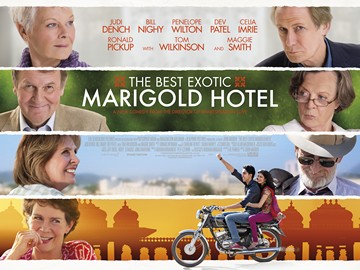
Why See This...The Best Exotic Marigold Hotel [2012]

      The Best Exotic Marigold Hotel is a coming of age story in a rather unlikely way.  Its main characters are not novice youngsters or young adults feverishly searching for their life’s purpose in the many daunting years ahead of them.  Hardly.  Instead, the characters that make up this story are all well over the hill and have had plenty of that kind of life experience.  But despite its displacement in the traditional sense of that genre, The Best Exotic Marigold Hotel basks in the seemingly youthful splendor and energy of a coming of age story.
      Immediately, the audience receives a crash course of introductions by way of the film’s seven main characters, all living in various parts of England, all unknown to each other’s own existence.  There’s the newly widowed housewife, Evelyn (Judi Dench), looking to sell her home and pay off her family’s debts; another woman, Muriel (Maggie Smith), in need of an affordable hip replacement (who is also racist); a judge by the name of Graham (Tom Wilkinson), who has been telling himself for years he will soon retire; Norman (Ronald Pickup), a single man of the Don Juan type always looking for some fun under the sheets despite his old age, Madge (Celia Imrie), a woman of similar stature that, despite a few unsuccessful marriages, still hopes to be swopped off her feet by a beloved Prince Charming.  And then there’s the groups’ only married couple, Douglas (Bill Nighy) and Jean (Penelope Wilton), who still appear much too young for their retirement community home, fit with too many handrails and an emergency button- but it’s all they can afford.  What groups these people together is the tight budget they must plan their retirement on, making this comfort that much harder to attain.  The introductions become hectic at first and almost too much too soon, but through each of their three minutes of screen time, we see that none of these folks are cinematic caricatures.  Each one is cleverly thought out and totally real.  No doubt there is a lonely Evelyn and a feisty old Norman out there in our world.  Their individual stories make the film much more real and relatable.  In their own ways, each character is trying to re-attain the peace of mind they had from years prior and this subsequently takes them to the same destination- India, where they all meet.

Thursday, May 24, 2012

Reel News...New Trailers/Teasers for "The Master," "The Great Gatsby" & "Anchorman Two"


      Big news today from three huge and highly anticipated upcoming movies.  Trailers and teasers have been released for Paul Thomas Anderson's The Master, Baz Luhrmann's adaptation of The Great Gatsby and of course, Anchorman Two.  Commentary  and videos for each project follow below.


The Master
To be honest, no one saw There Will Be Blood coming and no one was quite ready for what it held.  Sure, Paul Thomas Anderson has been steadily establishing himself as one of the few Hollywood auteurs with pictures like Boogie Nights, Magnolia and Punch Drunk Love, but There Will Be Blood seemed something beyond all these.  Many people call it a masterpiece.  Others, actually insisted the movie's ending tainted its own opportunity at such a title.  But if nothing else, everyone can agree Daniel Day-Lewis gave the performance of a lifetime, one that is surely up there with greatest ever.  For those who were left spellbound by Daniel Plainview & Co. (myself included), the five year hiatus of Paul Thomas Anderson has not been a favorable one.  Nonetheless, vague details about his follow up project, "something about a returning soldier and a new cult-like religion" had been out there for years and while nothing was ever confirmed, the untitled, upcoming project always carried the name The Master.

Well all that can be confirmed as The Master now has an official teaser trailer over at YouTube.  After producing an excellent score for There Will Be Blood, it makes sense that PTA has again grabbed Radiohead's Jonny Greenwood for the music.  It looks very much aligned with the same sort of unnerving dramatic tension that always hides within a PTA film.  So the bar should naturally be very high for this movie.  With no Daniel Day-Lewis, The Master now rests in the hands of Joaquin Phoenix.  Ever since he went AWOL from Hollywood, grew a huge beard and tried his luck at rapping in the I'm Still Here documentary (mockumentary?), Phoenix has yet to appear back on screen and re-establish himself as an actor of serious quality.  If he can do something along the lines of his impeccable Johnny Cash interpretation from Walk The Line (2005), then we have nothing to worry about.  We should expect great things.